Blog
Laser Genesis vs IPL: Which Treatment Is Right for Your Skin?

Laser Genesis and IPL are often discussed together because both can improve the appearance of redness, uneven tone and sun-damaged skin. However, they work in quite different ways, and choosing between them is less about which treatment is “better” and more about what we are actually trying to change in the skin.
At The Stockbridge Clinic, we use Cutera Laser Genesis and LimeLight IPL on the XEO+ platform. In practice, we often see patients who could potentially benefit from either treatment, particularly when redness and pigmentation exist alongside changes in texture or general skin quality. This is where looking closely at the skin becomes important.
If brown pigmentation or visible redness is the dominant concern, we may lean towards LimeLight IPL. If the skin needs broader rejuvenation, with concerns such as diffuse redness, enlarged pores, fine lines or uneven texture, Laser Genesis may be more appropriate. For some patients, the best answer is not Laser Genesis vs IPL at all. It is using both strategically.
The fundamental difference is the type of energy being delivered.
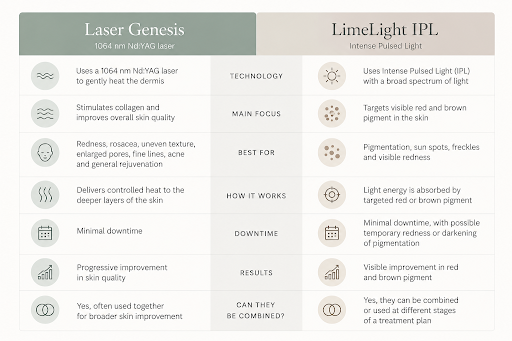
Laser Genesis uses a 1064 nm Nd laser. Rather than aggressively resurfacing the skin, it gently heats the dermis, stimulating collagen while helping to improve redness, inflammation and overall skin quality.
LimeLight IPL uses Intense Pulsed Light. Unlike a laser, which uses a specific wavelength of light, IPL delivers a broader spectrum of light that can be adjusted to target visible red and brown pigment within the skin.
This distinction influences what each treatment tends to do particularly well. Laser Genesis is generally more focused on progressive skin rejuvenation, while LimeLight IPL is particularly useful when unwanted colour, such as sun spots, freckles or redness, is clearly visible.
Laser Genesis is one of those treatments that can be useful when there is not necessarily one dramatic problem with the skin, but several smaller changes are beginning to affect its overall appearance.
It can be considered for concerns including redness, rosacea, uneven texture, enlarged-looking pores, fine lines, acne and acne scarring, as well as general skin rejuvenation.
The treatment delivers controlled heat into the deeper layers of the skin. This creates a gradual collagen-stimulating response without removing the surface of the skin, which is why there is typically little interruption to normal day-to-day activities. This progressive approach is also why Laser Genesis features within our wider approach to putting skin quality first, rather than treating individual concerns in isolation.
For someone whose skin is beginning to look less even, slightly rougher or more reactive, Laser Genesis can be a useful starting point. We may also consider it when redness exists alongside textural changes rather than presenting as the only concern.
One treatment can leave the skin looking fresher, but Laser Genesis is generally a progressive treatment. Where we are trying to create a more meaningful change in skin quality, a course may be recommended. This gradual approach is one of the reasons Laser Genesis can also work well as part of an ongoing skin maintenance and prevention strategy.
LimeLight IPL becomes particularly useful when we can clearly see areas of unwanted colour in the skin.
Repeated UV exposure can lead to freckles, sun spots and patches of pigmentation becoming more noticeable over time. Redness can also become increasingly visible, whether as a generally flushed complexion or areas of vascular colour.
LimeLight IPL delivers pulses of light into the skin, where the energy is absorbed by the targeted red or brown pigment. This makes it particularly suited to visible pigmentation, sun damage, freckles and redness.
A simple way to think about the difference is that Laser Genesis is often chosen when improving the overall quality of the skin is the priority, while LimeLight IPL can be more targeted when unwanted red or brown colour is driving the concern.
That does not mean every patch of pigmentation should automatically be treated with IPL. Pigmentation has different causes, depths and patterns, and effective pigmentation treatment may involve more than one approach. Before treating it, we need to establish what we are looking at and whether light-based treatment is appropriate.
The choice between Laser Genesis and LimeLight IPL depends primarily on what is creating the visible concern.
There can also be considerable overlap. Someone may have sun spots alongside redness, enlarged pores and early textural changes. In these cases, treating pigmentation alone may not address everything contributing to an uneven complexion, so Laser Genesis and LimeLight IPL may be combined or used at different stages of a treatment plan.
Ultimately, we would base the choice on the type and severity of the concern, skin sensitivity and what we can see during assessment rather than selecting a treatment from symptoms alone.
Yes. In fact, this can be one of the most useful approaches when the skin has several concerns at the same time.
Someone may have visible sun spots that respond well to LimeLight IPL but also have diffuse redness, enlarged pores and declining skin quality that would benefit from Laser Genesis. Treating only one element may improve the complexion, but it may leave the other concerns relatively unchanged.
Using Laser Genesis and LimeLight IPL within the same wider treatment plan allows us to approach the skin from different angles. IPL can target unwanted red and brown colour, while Laser Genesis can be used to support collagen production and improve broader skin quality.
The Stockbridge Clinic offers Laser Genesis and LimeLight IPL as a combined treatment, but this does not mean everybody needs both. For milder or isolated concerns, one technology may be perfectly adequate. Combination treatment becomes more useful when assessment shows there is genuinely more than one component to address.
Start with what you can see in your skin rather than the name of the treatment.
If the main issue is clearly defined pigmentation, freckles, sun spots or areas of visible redness, LimeLight IPL may be the more appropriate starting point. If your concerns are broader and include texture, pores, fine lines, diffuse redness and general skin quality, Laser Genesis may make more sense.
Where both colour and skin quality are contributing, a combined or staged plan can be considered.
Skin type, sensitivity, recent sun exposure, previous treatments and the severity of the concern all matter too. This is why two people asking about the same problem may leave a consultation with different recommendations.
The aim is not to use every technology available. It is to identify the main reason the skin looks the way it does and choose the simplest treatment plan likely to make a worthwhile difference.
They can, particularly if your concerns change throughout the year.
Skin rarely stays exactly the same. Pigmentation can become more apparent following periods of greater UV exposure, redness can fluctuate and collagen-related changes develop gradually with age. Treatment that was appropriate six months ago may not necessarily be what your skin needs next.
Laser Genesis and LimeLight IPL can therefore be used as individual treatments, combined when appropriate or incorporated into a longer-term programme based on how the skin responds. For patients who prefer a more structured approach, The Stockbridge Skin Protocol is built around this principle, with treatment selected according to what the skin needs at each stage rather than following the same routine every month.
This approach is particularly useful when the goal is not simply to correct one sun spot or prepare for one event, but to maintain clearer, healthier-looking skin over time.
This depends on how the skin looks and feels immediately afterwards. Laser Genesis usually involves minimal recovery, while IPL may leave temporary redness or sensitivity. Your practitioner will advise when it is appropriate to reapply products following treatment.
Periods when you are less likely to have significant sun exposure can make IPL treatment easier to plan. Because tanning and UV exposure can affect treatment suitability and increase the risk of unwanted pigment changes, your practitioner will discuss sun exposure before treatment.
Yes, but timing matters. Laser Genesis is often easier to accommodate closer to an event because downtime is minimal. IPL should usually be planned with enough time for temporary redness, swelling or darkening of pigmentation to settle. If you have an important date in mind, tell your practitioner before treatment.
Treated brown pigmentation can temporarily appear darker following IPL before it begins to clear. Your practitioner will explain what is expected after treatment and how to care for the skin while this process takes place.
Yes. Daily sun protection remains important after either treatment, particularly when pigmentation and sun damage are concerns. Treatment can improve existing visible changes, but it does not prevent new UV damage from developing.
If you are comparing Laser Genesis vs IPL, you do not need to decide which treatment to book based on a list of benefits.
What matters is whether the changes you are seeing are predominantly pigmentation, redness, texture, early collagen loss or, as is often the case, a mixture of several concerns. Once we establish that, we can decide whether Laser Genesis, LimeLight IPL or a combination gives us the most appropriate way to treat your skin.
If you are unsure whether Laser Genesis or IPL is right for you, book a consultation with our team and we can assess your skin, discuss what you would realistically like to improve and recommend the most appropriate next step.