Blog
How to Treat Jowls and a Sagging Jawline Without Surgery

A softer jawline is a common part of facial ageing, but it does not happen for the same reason in everyone. You might notice that the line between your face and neck is becoming less distinct, small jowls are appearing either side of the chin, or your lower face simply looks a little heavier than it used to.
Several changes can be responsible. Collagen loss can make the skin less firm, the tissues beneath the skin can gradually lose support, and changes in facial volume and bone structure can alter the shape of the lower face. Fat beneath the chin can also make the jawline look less defined. Genetics and your natural facial structure influence how and when these changes appear.
Understanding the cause matters because jowls and reduced jawline definition are not one problem with one solution. Loose skin needs a different approach from excess fat beneath the chin, while a jawline that has lost some of its underlying support may need something different again. Quite often, more than one change is involved.
At The Stockbridge Clinic in Edinburgh, we therefore look at the skin, fat, underlying tissues and overall facial structure when assessing the lower face. Here, we explain what can cause a jawline to change and which non-surgical treatments may help.
As we age, levels of collagen and elastin decline, making the skin less firm and resilient. Changes also take place beneath the skin. Facial fat shifts, the tissues lose some of their support and the underlying bone structure gradually changes. Together, these processes can contribute to the heaviness around the lower face that we recognise as jowls.
What sits beneath the chin matters too. Even a relatively small pocket of fat can soften the angle between the neck and jaw. This can happen in people who are otherwise slim, so having a less defined jawline does not necessarily have anything to do with overall body weight.
When we assess a jawline, we look at:
Once we know what is creating the change, it becomes much easier to decide which treatment is likely to be useful.
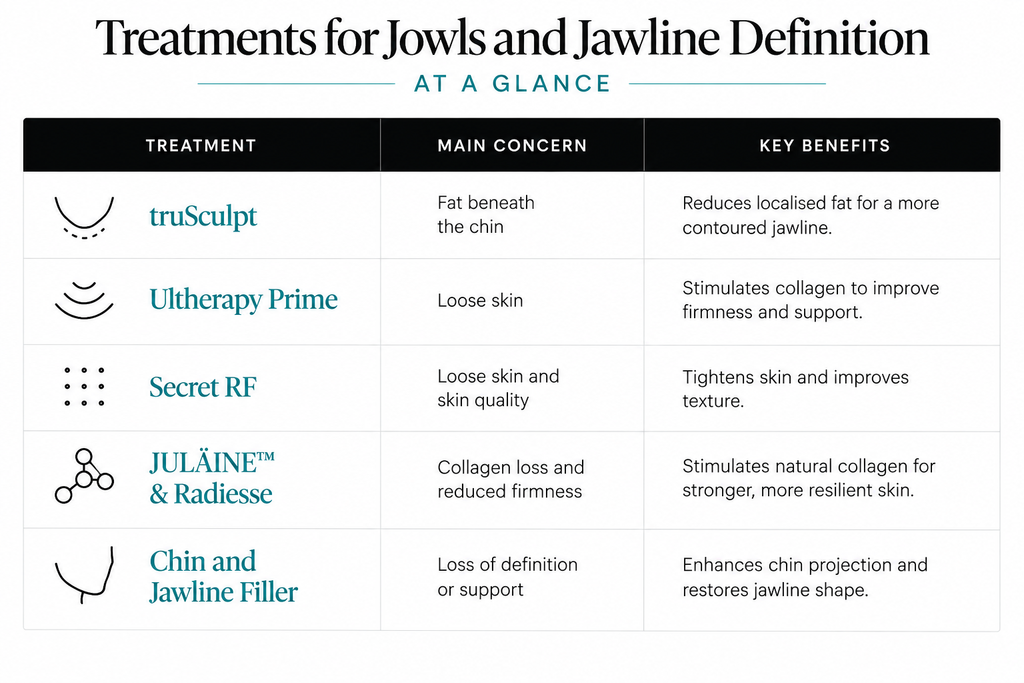
If a pocket of fat beneath the chin is hiding an otherwise reasonably defined jawline, reducing it can help create a clearer distinction between the face and neck.
truSculpt uses controlled radiofrequency energy to heat and target fat cells beneath the skin. The body then gradually clears the affected fat cells, so the change develops over time rather than appearing immediately.
The important thing is establishing whether the fullness you can see is actually fat. What looks like a double chin can sometimes be partly, or mainly, loose skin.
Where there is a distinct pocket of fat and the skin still has reasonably good firmness, reducing the fat can reveal more of the natural jaw and neck contour. If the skin is also loose, we may need to consider skin tightening as part of the overall plan.
If loose skin is making the jawline look softer, treatment needs to focus on improving firmness and encouraging new collagen. Two options we use are Ultherapy Prime and Secret RF, although they work in different ways.
Ultherapy Prime uses focused ultrasound energy at specific depths beneath the skin. This stimulates the body’s natural collagen response, helping the tissues become firmer and better supported over time. It can be used across the lower face, beneath the chin, jawline and neck, and is often considered when there is early to moderate looseness and the jawline is beginning to soften.
The important thing to know is that the change is gradual. Ultherapy Prime does not add volume or suddenly reshape the face. Instead, new collagen develops over the following months, gradually improving firmness and support.
Secret RF combines microneedling with radiofrequency energy. Very fine needles enter the skin and deliver RF energy at controlled depths, encouraging the skin’s natural repair response and the production of new collagen. It can be particularly useful when the jawline is becoming slightly looser and the skin itself is beginning to look or feel less firm.
This is where choosing between treatments becomes more individual. Someone with more noticeable laxity may need a different approach from someone whose main concerns are mild looseness together with changes in skin texture and firmness.
There are also limits to what non-surgical tightening can achieve. These treatments are generally best suited to mild to moderate laxity. If there is a significant amount of loose or descended tissue, they cannot produce the same degree of lifting or repositioning as surgery.
Sometimes there is no significant pocket of fat and the skin is not particularly loose, yet the lower face still looks less firm and defined than it once did. In these cases, loss of collagen and tissue quality may be playing a bigger role.
Collagen biostimulators such as JULÄINE™ and Radiesse can be useful here. Rather than simply adding volume, they encourage the tissues to produce more of their own collagen.
JULÄINE™ contains poly-L-lactic acid microspheres and works by stimulating collagen production gradually. It may be considered when the aim is to improve firmness, resilience and support without immediately changing the shape or volume of the face.
Radiesse contains calcium hydroxylapatite microspheres. It can provide support while also stimulating collagen production over time.
This distinction matters. If someone already has good chin and jaw proportions but the skin and tissues over them have become less firm, simply adding filler along the jawline may not solve the problem. Improving the quality and support of those tissues can sometimes be a more appropriate approach.
As with other collagen-stimulating treatments, the change develops gradually as new collagen is produced.
Chin and jawline filler can be useful when the natural shape of the chin or jaw is contributing to the concern. Carefully placed filler can improve chin projection, strengthen selected areas of the jaw or create a clearer lower-face contour.
The chin can make more difference to the jawline than many people realise. If it is naturally small or sits slightly further back, the jawline may appear softer from both the front and side. Changes that occur with age can make this more noticeable. This does not mean that the answer is simply to put filler wherever the jaw looks less defined.
At The Stockbridge Clinic, we often see patients who assume that treating jowls means filling directly around them. We actually need to look at the chin, jaw and rest of the lower face together. Adding too much filler to a face that is already becoming heavier can make the lower face look wider rather than more defined.
The aim is to use filler only where additional shape or support would genuinely improve the overall proportions of the face.
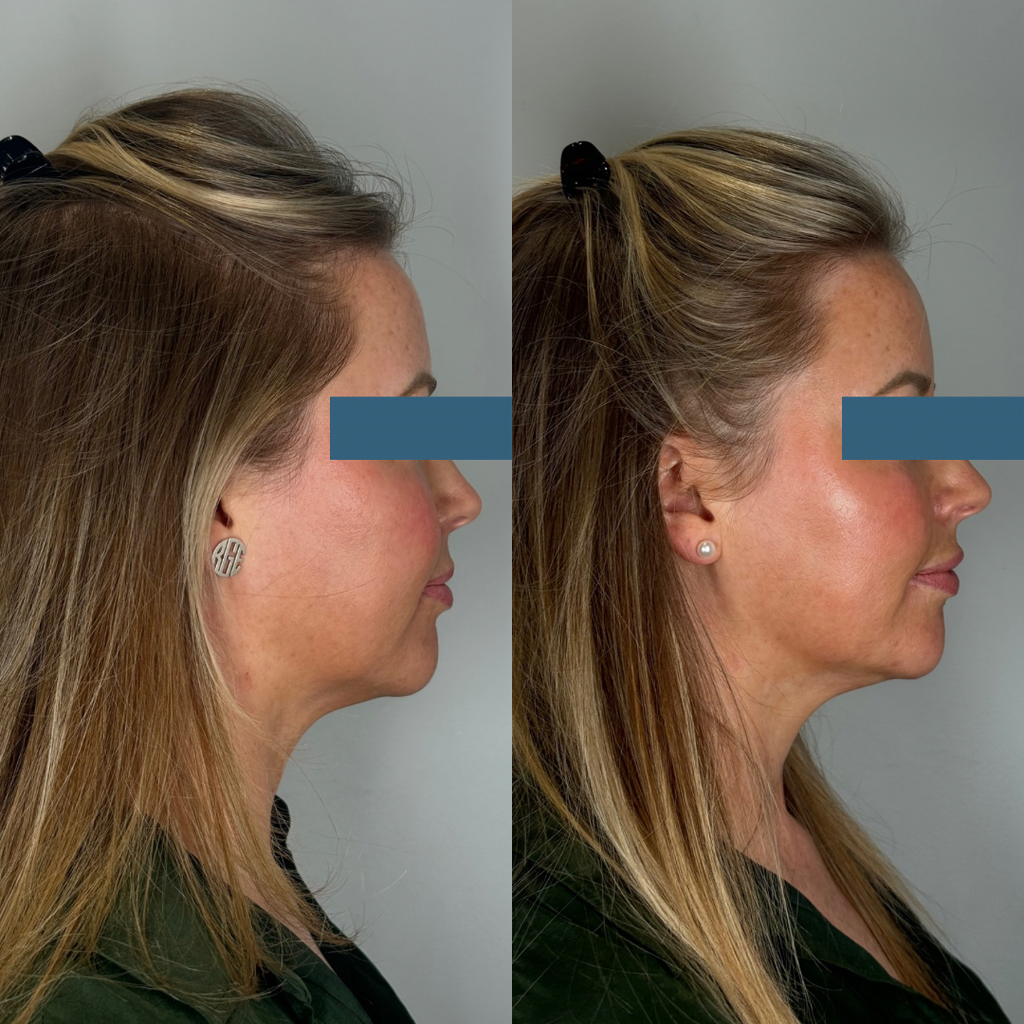
Before and After Chin & Jaw Enhancement
There is no single best treatment for jowls because the right approach depends on what is causing the jawline to lose definition. Loose skin, fat beneath the chin, collagen loss and reduced facial support all require different approaches, and often more than one factor is involved.
Not necessarily. If fat beneath the chin is contributing, losing weight may make some difference. However, jowls can also develop because of loose skin and changes in the tissues and structure of the face. Significant weight loss can sometimes make loose skin more noticeable.
No face is completely symmetrical. Differences in bone structure, muscles, dental anatomy and the distribution of facial tissues can all make one side of the jawline look slightly different from the other. These differences can also become more noticeable with age.
There is no particular age at which jowls begin. Genetics, facial structure, skin quality, sun exposure and the way your individual face ages all play a part. Some people notice early changes in their thirties, while others retain a defined jawline for much longer.
Skincare can help maintain the condition and quality of the skin, but creams and serums cannot significantly lift loose tissue or replace support that has been lost deeper within the face. If jowls are becoming noticeable, it is useful to establish whether the change is mainly within the skin or happening at a deeper level.
We cannot completely prevent the normal changes that happen to the face with age. Protecting your skin from UV exposure and looking after your general skin health can, however, help protect collagen and skin quality. If you are beginning to notice changes, an assessment can help establish what is happening and whether treatment is necessary at all.
If you are noticing jowls, fullness beneath the chin or a gradual loss of jawline definition, the most useful first step is finding out what is causing the change.
At The Stockbridge Clinic, we see patients from Stockbridge, across Edinburgh and the surrounding areas for assessment of the lower face. We can look at the different factors affecting your jawline and explain whether fat reduction, skin tightening, collagen stimulation, filler or a combination of approaches is likely to be appropriate.
Book a consultation if you would like to discuss your jawline and the options available.