Blog
Oral Semaglutide: Could a Daily Weight Loss Tablet Be Right for You?

For many people considering medical weight loss, weekly injections can feel like a barrier to treatment. Oral semaglutide offers an alternative, delivering semaglutide in a single daily tablet for suitable patients.
Like injectable GLP-1 medications, oral semaglutide works by helping to regulate appetite, reduce food cravings and increase feelings of fullness. However, it isn’t suitable for everyone, and choosing the right treatment requires a thorough medical assessment.
This guide explains how oral semaglutide works, who may be suitable, how it compares with injections, potential side effects and what to expect from treatment.
Oral semaglutide is a prescription-only medication belonging to a group of medicines called GLP-1 receptor agonists. GLP-1 is a naturally occurring hormone involved in regulating appetite, blood sugar and digestion. Oral semaglutide works by mimicking this hormone, helping to:
Rather than relying purely on willpower, many patients find that the constant thoughts about food become much quieter, allowing healthier eating habits to feel more achievable.
Like injectable semaglutide, Oral semaglutide works best when combined with dietary changes, increased physical activity and ongoing clinical support. It is not intended to replace healthy lifestyle choices but to make them easier to maintain over time.
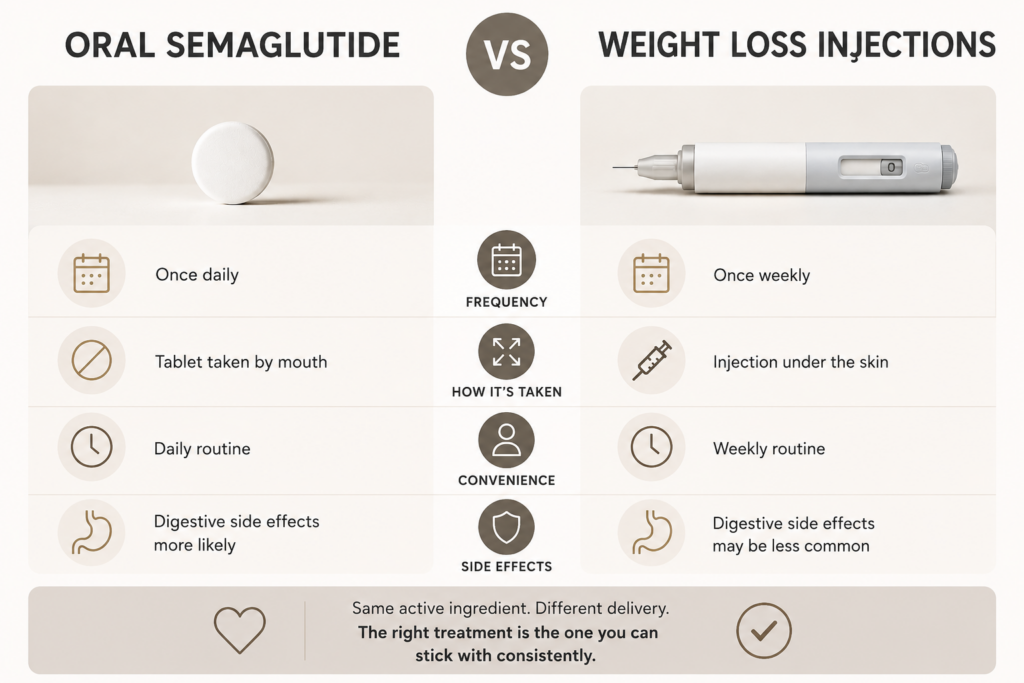
One of the biggest questions patients ask is whether tablets work differently from injections.
The answer is that both treatments use semaglutide as the active medication. The main difference is how the medicine is delivered.
Oral semaglutide is not suitable for everyone, which is why every patient should undergo a thorough medical assessment before treatment is prescribed.
During your consultation, your doctor will consider factors including:
Some patients may be excellent candidates for Oral semaglutide, while others may achieve better outcomes with Wegovy or Mounjaro, both of which are already available as part of our doctor-led Medical Weight Management Programme.
There is no single medication that is best for everyone. Individual assessment always comes first.
As GLP-1 medications become more widely available, many people are understandably tempted by online providers offering quick prescriptions with minimal contact.
Our extensive experience tells us that this is where patients can sometimes struggle.
Medication doses often need adjusting. Side effects require careful management. Nutritional intake needs monitoring, particularly as appetite decreases. Some patients also benefit from additional support around eating behaviours and long-term weight maintenance.
At The Stockbridge Clinic, every patient begins with a face-to-face consultation with one of our doctors before any prescription is considered. We continue to monitor progress closely, with regular follow-up appointments, direct access to your prescribing doctor and nutritional support built into the programme.
This ongoing relationship allows treatment to evolve as your body changes.
While every patient’s experience is different, Oral semaglutide may offer several advantages.
Many patients appreciate:
Many patients also notice improvements beyond the number on the scales. Better mobility, increased energy, improved sleep and greater confidence often become just as important as weight loss itself.
Like all prescription medicines, Oral semaglutide can cause side effects.
The most common include:
These symptoms are often most noticeable when treatment first begins or after dose increases and usually improve as the body adjusts.
At The Stockbridge Clinic, we spend time preparing patients before treatment starts so they know what to expect. Small adjustments to eating habits, hydration and meal timing often make a significant difference during the first few weeks.
Having regular contact with your prescribing doctor also means concerns can be addressed early rather than waiting until your next prescription.
Medication can be incredibly effective, but it is rarely the complete answer.
One of the reasons our Medical Weight Management Programme has been designed differently is because sustainable weight loss usually depends on several factors working together.
Alongside pharmaceutical treatment, we include medical monitoring, nutritional assessment and ongoing support throughout your journey. Our doctors frequently review progress and, where appropriate, adjust treatment to help maintain steady results while minimising side effects.
For some patients, medication may only be needed for a defined period while healthier habits become established. Others may benefit from longer-term treatment under medical supervision.
The goal is never simply rapid weight loss. It is helping patients achieve healthier, sustainable outcomes they can maintain.
Both contain semaglutide as the active ingredient. The most appropriate option depends on your medical assessment, lifestyle and clinical needs.
The tablets are taken once daily following specific instructions to ensure the medication is absorbed properly. Your doctor will explain exactly how to take it.
Oral semaglutide is a prescription-only medicine and should only be prescribed following an appropriate medical assessment by a qualified healthcare professional.
Yes. Ongoing monitoring helps ensure treatment remains safe, effective and appropriately adjusted as your weight changes.
Yes, in many cases, this may be possible. Your doctor will assess whether changing medication is appropriate based on your progress and medical history.
If you’re interested in Oral semaglutide, Wegovy or Mounjaro, choosing the right treatment starts with understanding your individual health rather than following trends.
At The Stockbridge Clinic, our doctor-led Medical Weight Management Programme provides careful assessment, evidence-based prescribing and personalised support throughout your journey. If you’re considering medical weight loss and would like expert advice on which option may be most suitable, we’d be delighted to welcome you for a consultation at our clinic in Edinburgh.