Blog
Skin Boosters vs Polynucleotides: What’s the Difference and Which Is Right for Your Skin?

If your skin feels drier, thinner or less resilient than it used to, you may have come across two increasingly popular options: skin boosters and polynucleotides.
Both are injectable treatments designed to improve skin quality rather than dramatically change the shape of your face. Both can be useful for concerns such as dullness, fine lines and declining elasticity. However, they do not work in quite the same way, and choosing between them should involve more than simply deciding which treatment is currently receiving the most attention.
At The Stockbridge Clinic in Edinburgh, we tend to start with the skin itself. Is dehydration the main issue? Is the skin becoming crepey or less elastic? Are we treating delicate under-eye skin? Is there evidence of sun damage, or are we trying to support skin that simply does not seem to recover as well as it once did?
Those distinctions help us decide whether a skin booster, polynucleotides or, in some cases, a carefully planned combination is more appropriate.
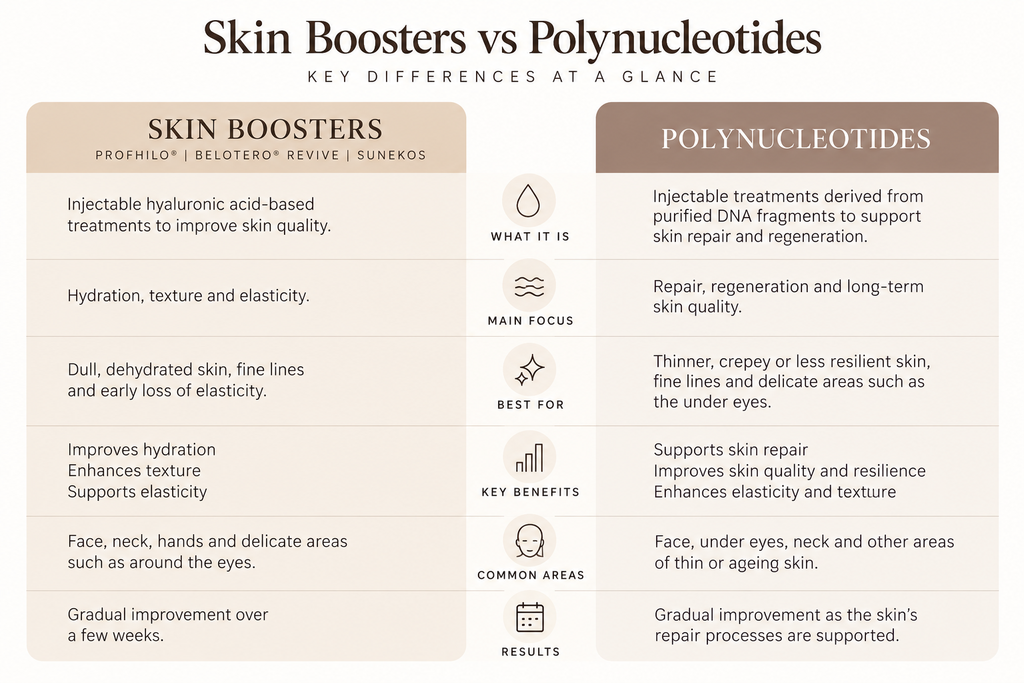
The simplest distinction is that skin boosters are primarily used to improve hydration and overall skin quality, while polynucleotides place greater emphasis on supporting repair and regeneration within the skin.
That is a useful starting point, but there is overlap.
Many injectable skin treatments influence more than one aspect of skin health. Improving hydration can make fine lines appear softer and skin feel more supple, while treatments that support regenerative activity can also improve hydration, elasticity and texture over time.
This is why we would not normally choose a treatment based on one word such as “glow”, “hydration” or “ageing”. We look at what is happening within the skin and what needs the most support.
Skin boosters are injectable treatments placed into or beneath the skin to improve its hydration, texture, elasticity and general quality.
Unlike traditional dermal fillers, they are not primarily being used to build cheekbones, project the chin or replace significant facial volume. Their role is much more about the condition of the skin itself.
At The Stockbridge Clinic, skin-quality treatments include Profhilo®, BELOTERO® Revive and Sunekos. Although these treatments can sit within the same broad category, they should not be treated as interchangeable because their formulations and intended roles differ.
Profhilo® is a hyaluronic acid-based injectable treatment used when hydration, elasticity and skin laxity are important concerns.
Hyaluronic acid attracts and retains water, so Profhilo can be particularly useful for skin that has started to feel less supple or looks tired and dehydrated. Rather than creating conventional filler-like volume, it is distributed through the treatment area to improve skin quality more broadly.
We may consider it when someone has relatively good facial structure but feels their skin has become less firm, luminous or hydrated. The face is a common treatment area, but Profhilo can also be used on areas such as the neck and hands.
BELOTERO® Revive is another injectable hyaluronic acid skin booster. It is designed to improve hydration, firmness, texture and the appearance of early sun-related skin changes.
This can make it particularly relevant for someone whose concern is not simply dryness. Skin that has accumulated environmental and UV damage can become rougher, less even and less reflective of light, so restoring hydration can form one part of improving its overall appearance.
We often find that patients describe this type of skin as looking “tired” even when they are well rested. In reality, what they are noticing may be a combination of dehydration, uneven texture and early changes in elasticity.
Sunekos combines hyaluronic acid with amino acids and is used to support hydration, collagen and elastin production.
It can be particularly useful where skin has become thin, crepey or less elastic, including delicate areas such as around the eyes. Different Sunekos formulations can also be considered according to the degree of skin ageing and the area being treated.
The important point is that “skin booster” does not describe one identical treatment. The right product depends on the condition of the skin, the treatment area and what we are trying to achieve.
Polynucleotides take a more regenerative approach.
They are injectable compounds derived from purified DNA fragments and are used to support the biological processes involved in skin repair and renewal. Within the skin, polynucleotides can support fibroblast activity, the cells involved in producing important structural proteins such as collagen and elastin.
Rather than simply supplying hydration, the aim is to encourage an environment in which the skin can function and repair more effectively.
This makes polynucleotides particularly interesting when we are looking at changes such as reduced elasticity, fine lines, compromised skin quality or delicate, ageing skin.
Results tend to develop gradually. This is not a treatment we would choose because somebody wants their face to look noticeably different tomorrow. The changes are generally more about the skin becoming healthier-looking, smoother and more resilient over time.
The better option depends less on age and more on what is actually happening within the skin. Dehydration, thinning, fine lines, reduced elasticity and changes around the eyes can occur together, but they do not necessarily need the same treatment.
As a general guide:
The under-eye area is a good example of why assessment matters. Dark circles or a tired appearance can result from thin skin, pigmentation, dehydration, volume loss or visible underlying vessels. Improving the skin itself can help in the right patient, but a skin booster or polynucleotide treatment will not necessarily correct true hollowness or every type of dark circle.
In practice, we would usually treat the most significant concern first. Someone with otherwise healthy skin that is predominantly dehydrated may benefit more from a skin booster, whereas thinner, crepey skin with declining resilience may lead us towards polynucleotides. Where several changes overlap, treatment can be staged rather than expecting one injectable to address everything.
Yes. Skin boosters and polynucleotides can be combined when there are different aspects of skin quality to address, although they do not necessarily need to be performed at the same appointment.
For example, dehydrated skin that is also becoming thin or less resilient may benefit from a skin booster for hydration alongside polynucleotides to support repair and longer-term skin quality. Where texture, scarring, laxity or redness are also present, treatments such as Secret RF Microneedling or Laser Genesis may form part of a wider, staged plan.
At The Stockbridge Clinic, treatment choice is based on the condition of the skin rather than simply selecting a particular injectable. An OBSERV 520x skin analysis can provide additional information where appropriate.
Generally, a skin booster may be favoured when dehydration and dullness are the main concerns, while polynucleotides may make more sense for thinner, crepey or less resilient skin. When several concerns overlap, we can address them in stages and assess how the skin responds before deciding whether another treatment would add a meaningful benefit.
Yes. Having previously had a skin booster does not mean you need to continue with the same treatment indefinitely. Skin changes with age, hormones, seasons and environmental exposure, so it is sensible to reassess whether the treatment still matches your priorities.
There is no set age. Treatment should be based on skin condition rather than a birthday. Some people develop dehydration or early sun damage relatively young, while others maintain good skin quality much later. Assessment is more useful than treating preventatively simply because you have reached a certain age.
Yes. Both treatments can be considered for men where the skin concern and medical assessment make them appropriate. Treatment planning is based on the skin rather than gender.
Temporary swelling or small raised areas can occur around injection sites. These usually settle. Neither treatment is intended to create the type of facial volume associated with conventional volumising filler, although the expected response varies according to the product and treatment area.
Potentially, but injectable treatments should not be booked immediately before an important event. Redness, swelling or bruising can occur, even if you have previously experienced very little downtime. Your clinician can help you plan treatment with enough time for the skin to settle.
If you are comparing skin boosters and polynucleotides, you do not need to decide which injectable you need before coming to see us.
A consultation allows us to assess the quality of your skin, establish whether hydration, elasticity, regenerative support or another concern should take priority, and recommend treatment only where it is likely to add something worthwhile.
The Stockbridge Clinic welcomes patients from across Edinburgh and surrounding areas for doctor-led aesthetic and regenerative care. If you would like to understand what your skin needs rather than simply choose from a treatment menu, you can book a consultation and we can build a plan around your skin as it is now.