Blog
Why Your Face Can Look Older After Weight Loss and What You Can Do About It
Losing weight can have significant benefits for your health and wellbeing, but some people are surprised by how much their face changes too.
Cheeks may look flatter, temples more hollow and existing lines more noticeable. Others find that the lower face looks less defined, with early jowls or looser skin around the jaw and neck. The skin itself may also appear finer or more crepey.
These facial changes after weight loss are partly related to losing facial fat, which contributes to the shape and support of the face. If collagen and elasticity have already declined, the skin may also be less able to adapt to that reduction in volume.
At The Stockbridge Clinic in Edinburgh, we often see several of these changes together. The important part is establishing whether the main issue is lost volume, reduced tissue support, skin laxity, skin quality or residual fat, as each requires a different approach.
The face is made up of several layers, including bone, muscle, fat and skin. Facial fat is arranged in different compartments, some of which contribute significantly to the shape of areas such as the cheeks and temples.
When you lose a substantial amount of weight, some of this facial fat may reduce too. How noticeable that becomes varies from person to person. Your age, genetics, facial structure, amount of weight lost and existing skin elasticity can all influence how your face adapts.
Younger skin with good elasticity may contract relatively well around a slimmer face. Where collagen and elastin have already declined, reduced volume can reveal or exaggerate changes that were previously less noticeable.
This is why weight loss can sometimes appear to make the face age quite quickly, even though it has not suddenly caused the ageing process itself.
Several changes can happen at the same time, although their extent varies considerably.
The cheeks and temples are often where volume loss is easiest to see. Cheeks may become flatter, cheekbones more prominent and the temples more hollow.
For some people, this simply creates greater facial definition. More pronounced volume loss, however, can give the face a drawn or tired appearance.
It can also change how existing lines look. With less support through the mid-face, folds around the nose and mouth may appear deeper even though the fold itself has not necessarily changed significantly.
It can seem strange to lose weight but find that the jawline looks less defined. This usually happens because facial definition depends on more than the amount of fat present.
Reduced support through the face combined with lower skin elasticity can make early jowls more apparent. Beneath the chin and around the neck, the skin may not contract completely, leaving looseness, fine creasing or a more crepey appearance.
Some people also retain a small pocket of localised fat beneath the chin despite losing weight elsewhere. A soft jawline after weight loss can therefore be caused by laxity, residual fat, reduced facial support or a combination of these.
With less volume beneath it, the condition of the skin itself can become more noticeable. Fine lines, crepiness and uneven texture that were relatively subtle before may stand out more.
Weight loss is not necessarily responsible for all of these changes. Age, hormones, genetics, sun exposure and skincare habits continue to affect collagen levels and skin quality independently.
This distinction becomes important when considering treatment. Restoring volume will not correct poor skin texture, just as improving the skin will not replace a genuinely hollow cheek.
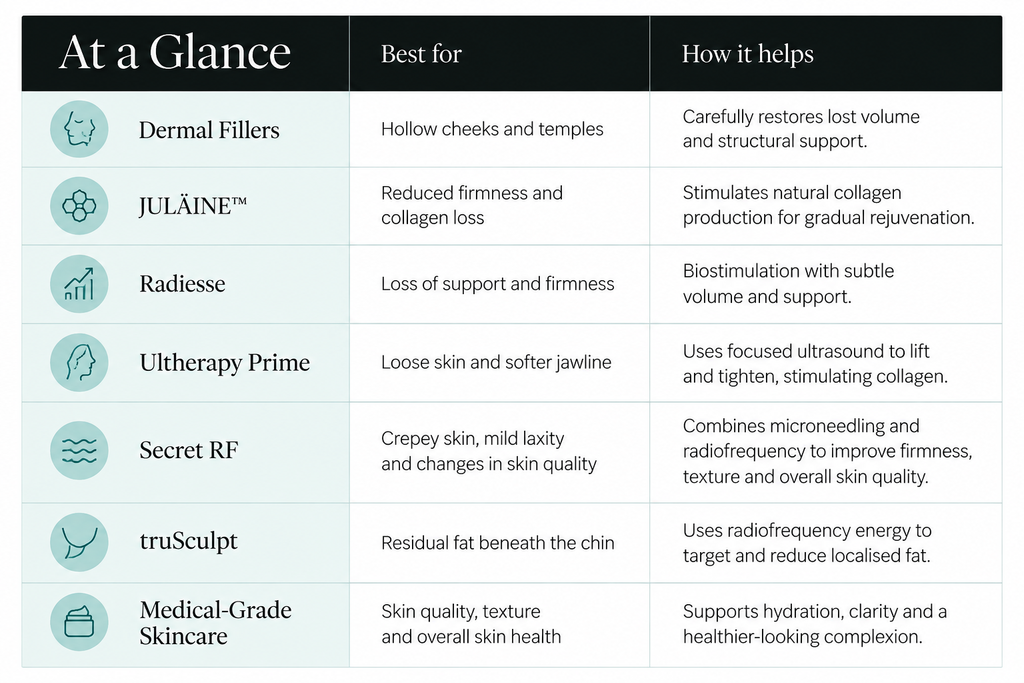
Where genuine volume loss is creating hollowing or reduced support, dermal fillers may be considered. Depending on where volume has been lost, this could include cheek and mid-face filler or temple filler.
After weight loss, filler is generally most useful when it is used selectively rather than trying to replace every bit of facial fullness that has been lost. The aim is to restore balance and support while preserving the person’s new facial proportions.
For example, flattening through the cheeks may benefit from carefully restored mid-face support, while temple hollowing requires a different assessment and treatment approach. Where the lower face lacks structural definition, chin and jawline filler may sometimes be considered, but only where lack of support is genuinely contributing.
If the main problem is loose skin rather than lost volume, adding filler is unlikely to provide the right answer.
Not every post-weight-loss face needs additional volume. Sometimes facial proportions remain good, but the tissues have become less firm and resilient.
This is where treatments designed to stimulate collagen may be considered.
JULÄINE™ is a poly-L-lactic acid collagen biostimulator. Rather than primarily filling a hollow immediately, it encourages new collagen production, so improvements in firmness and support develop gradually.
Radiesse contains calcium hydroxylapatite microspheres and combines biostimulation with an element of structural support. Depending on how it is used, it can be useful where subtle support and improved collagen production are both desirable.
The distinction is important. Dermal filler primarily replaces or creates volume, while biostimulatory treatments work more through improving the tissue itself. In practice, some patients need one approach and others have elements of both.
Where laxity is the dominant concern, Ultherapy Prime may be more relevant than replacing volume.
It uses focused ultrasound energy at controlled depths beneath the skin to stimulate collagen production. This can gradually improve firmness and definition around areas such as the lower face, jawline, beneath the chin and neck.
It tends to be most useful for mild to moderate laxity where there is enough collagen response to produce a worthwhile improvement.
There are limits. Non-surgical tightening cannot remove substantial excess skin following major weight loss, and this should be recognised when deciding whether treatment is appropriate.
Secret RF microneedling can be particularly useful when laxity is accompanied by changes in skin quality.
It combines microneedling with radiofrequency energy delivered beneath the skin, stimulating a repair response and new collagen and elastin production.
For example, someone may have relatively little excess skin but notice that the lower face or neck looks less firm, finer or more crepey than it did before. Secret RF allows the focus to be on both skin quality and tightening, rather than adding volume where it is not needed.
Medical-grade skincare and appropriate skin treatments can complement this approach where hydration, pigmentation, texture or general skin health also need attention.
Weight loss does not always remove localised fat evenly.
If a small pocket remains beneath the chin and is contributing to poor jawline definition, truSculpt may be considered. It uses radiofrequency energy to target localised fat and is a contouring treatment rather than a method of losing weight.
The key is confirming that the fullness is actually caused by fat. If loose skin is responsible, further fat reduction could make the area appear more lax rather than more defined.
Yes. Volume loss, skin laxity and changes in skin quality often occur together, so a combination approach can sometimes give a more balanced result.
For example, lost facial support may be addressed first before reviewing remaining laxity or skin quality. Dermal fillers or biostimulators such as JULÄINE™ and Radiesse can address volume and tissue support, while Ultherapy Prime or Secret RF may be considered where tightening and collagen stimulation are the priority. truSculpt has a different role where residual localised fat beneath the chin is affecting definition.
The most appropriate approach depends on what has changed following weight loss, whether that is facial volume, skin firmness, skin quality or residual localised fat. Treatment can then be prioritised and staged rather than trying to address everything at once.
If you are still losing a significant amount of weight, your facial proportions may continue to change. This is particularly relevant before replacing volume or altering facial structure. Once weight has been reasonably stable, it becomes easier to judge which changes are likely to remain and how much correction, if any, is appropriate.
Skin health can still be supported during weight loss, but decisions about restoring facial volume generally become clearer once the face has had time to settle.
It can sometimes look less drawn once your weight and general health have stabilised, but facial fat that has been lost will not necessarily return. Giving your face time to settle can provide a clearer idea of which changes are lasting.
Not necessarily. The way your face responds depends on several factors, including genetics, age, skin elasticity, facial fat distribution and the total amount of weight lost. Losing weight gradually cannot guarantee that hollowing or laxity will not occur.
Fat distribution is individual, and some people naturally lose more noticeable volume from the face than others. Your underlying facial structure can also make relatively small changes in facial fat more visible.
There is limited evidence that facial exercises can meaningfully tighten lax skin. Exercise can strengthen muscles, but it does not replace lost facial fat or restore collagen in the same way as treatments designed to target these tissues.
There is no need to treat a face simply because it looks slimmer after weight loss. For many people, greater definition is a positive change. If persistent hollowing, laxity, jowls or changes in skin quality are bothering you, the first step is working out which tissues are responsible.
At The Stockbridge Clinic on Dean Street in Edinburgh, we can assess facial volume, skin firmness, skin quality and any residual localised fat together. From there, we can advise whether treatment is appropriate and, if so, which approach is most likely to make a worthwhile difference.
If you are based in Edinburgh, Stockbridge or the surrounding areas, you can book a consultation to discuss the facial changes you have noticed following weight loss.